
If you’ve spent any time building, deploying, or paying the bills for modern AI systems, you’ve likely stared at an API dashboard late at night with a mix of awe and mild terror. You build a sleek prototype, run a couple of automated tasks, and suddenly your token usage graph looks like a sheer cliff wall.
When you start digging into the culprits behind massive AI token consumption, two major suspects consistently pop up on the radar: the Model Context Protocol (MCP) and coding agents.
At first glance, comparing the two sounds like comparing apples to oranges. MCP is an open standard designed to connect AI models to external tools, databases, and APIs. Coding agents (like Claude Code, Devin, AutoGPT, or custom multi-agent coding loops) are autonomous software entities that plan, write, execute, and debug code to accomplish a complex development task.
Yet, as AI infrastructure matures, these two paradigms are colliding. Developers are plugging MCP tools into coding agents to give them superpowers and watching their token budgets implode in the process.
So, who is the real token glutton here? Does MCP spend more tokens, or do coding agents?
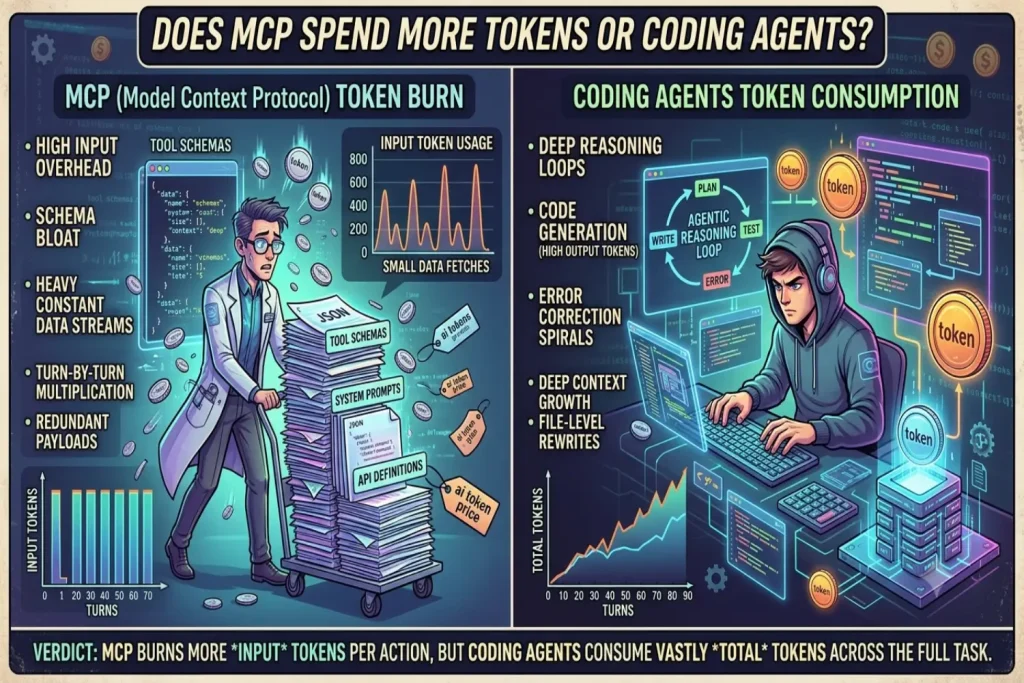
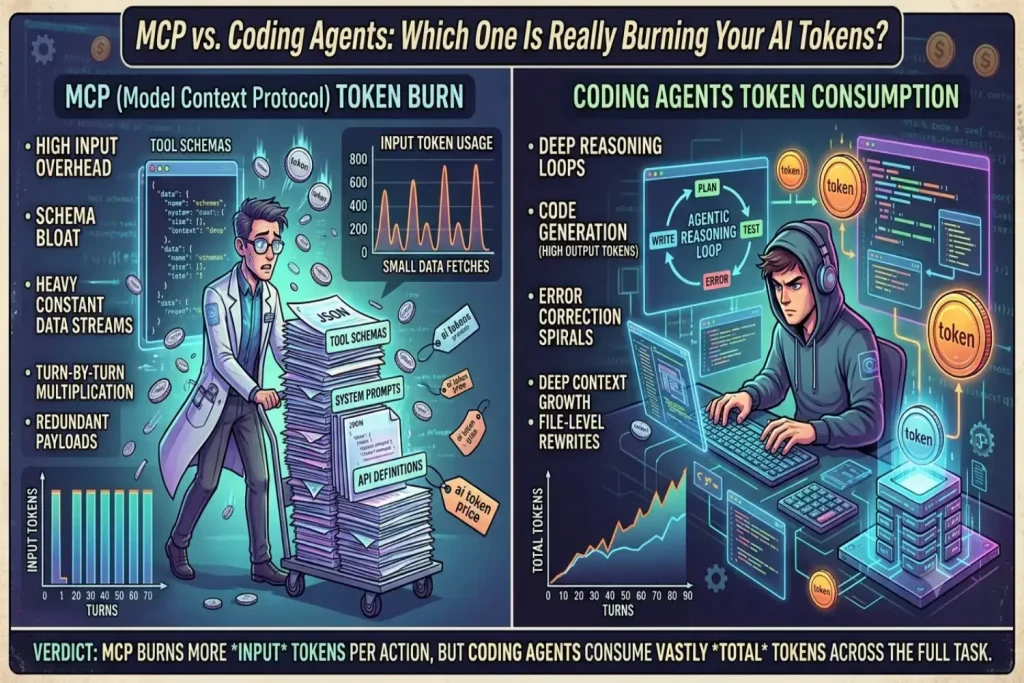
The short answer? Traditional MCP setups consume vastly more redundant input tokens per step due to schema bloat, but coding agents consume vastly more total tokens over the life cycle of a task due to deep recursive reasoning loops.
However, when you look at the economics, the architecture, and the actual AI token price, the nuance is far more interesting and potentially much more expensive than a simple one-line answer. Let’s dissect what’s happening under the hood, pull back the curtain on real production workflows, and figure out how to keep your AI infrastructure from draining your bank account.
1. Deconstructing the Heavyweights: How They Spend AI Tokens
To understand where your money is going, you first have to understand how each technology consumes context. Tokens aren’t just burned when an AI generates text (output tokens); they are burned every single time you send information to the AI (input tokens).
The AI Tokens Anatomy of MCP (Model Context Protocol)
Anthropic introduced the Model Context Protocol to solve a massive developer headache: standardizing how LLMs talk to third-party data sources and tools. Instead of writing custom API integration code for every tool, MCP gives you a universal client-server adapter.
Sounds clean, right? But here is the dirty secret of classical MCP implementation: schema overhead. When you connect an LLM to an MCP server, the MCP client injects the full JSON schema definition for every single available tool directly into the system prompt on every single turn:
| Layer in the MCP context window | Typical size |
|---|---|
| System prompt & instructions | Baseline |
| Tool 1 JSON schema: GitHub API | ~1,500 tokens |
| Tool 2 JSON schema: Postgres query | ~2,000 tokens |
| Tool 3 JSON schema: Slack webhook | ~1,200 tokens |
| Tool 4 JSON schema: local file system | ~1,800 tokens |
| User prompt (e.g. “Fix the bug in main.py”) | Small but the schema payload above is re-sent with it every turn |
- Static schema payload: If you have 10 MCP tools loaded, you might be adding 3,000 to 10,000 AI tokens to the context window before the model even reads the word “Hello”.
- Turn-by-turn multiplication: In a multi-turn conversation, that entire schema payload is resent on every single turn. If a conversation takes 15 turns, you aren’t paying for that 5,000-token schema once you are paying for it 15 times (5,000 × 15 = 75,000 input AI tokens) just to maintain the awareness that those tools exist.
- Raw intermediate data pipeline: When an MCP tool executes, its raw JSON or string response gets piped directly back into the model’s context window. If an MCP tool fetches a 500KB log file, that whole log file enters the context, blowing up your token count instantly.
The AI Tokens Anatomy of Coding Agents
Coding agents operate on a completely different behavioral loop: ReAct (Reasoning + Acting) and recursive refinement. A coding agent doesn’t just answer a prompt; it takes a goal (e.g. “Refactor our authentication middle ware to support OAuth2”), breaks it down into steps, writes code, executes tests, reads stack traces, corrects its own errors, and repeats:
- Plan & analyze the codebase
- Write / edit the file
- Run the terminal / tests – the loop repeats 20–50x, with the context window growing with every terminal output, file read, and stack trace
- Error encountered → self-correct – and the loop starts again
Here is where the token counter goes into hyper-speed for coding agents:
- Context accumulation: As the agent navigates directories, opens files, reads docs, and runs terminal commands, every piece of output gets appended to its growing conversation history.
- Deep iteration loops: A complex task rarely succeeds on turn 1. An agent might cycle through 30, 50, or 100 turns. By turn 40, the context window is holding the entire history of every file it read, every failed command, every error message, and every plan revision.
- High output generation: Unlike simple search or classification tools, coding agents generate massive blocks of text (code). Output tokens cost roughly 3x to 4x more than input tokens across major model providers.
2. Head-to-Head: The AI Tokens Burn Breakdown
To understand which one is eating your budget faster, we have to look at how input tokens, output tokens, and architecture interact.
| Consumption metric | MCP (Model Context Protocol) | Coding agents |
|---|---|---|
| Primary token drain | Fixed input overhead (schema & descriptions) | Variable context growth & output tokens |
| Scaling behavior | Scales with tool count & turn count | Scales with task complexity & loop count |
| Output-to-input ratio | Very low (mostly JSON tool calls & short responses) | Moderate to high (generates files, scripts, and logs) |
| Waste factor | High (payloads sent repeatedly even if tools are unused) | High (failed attempts and redundant file reads in history) |
| Impact of model choice | Hurts on high-cost input models | Hurts on high-cost output & reasoning models |
Scenario 1: The Short Task (e.g. “Check status of PR #42”)
- MCP: Loads 15 tool schemas (8,000 tokens) → makes 1 tool call (200 tokens) → receives response (500 tokens). Total: ~8,700 tokens.
- Coding agent: Receives prompt → runs
gh pr view 42via terminal (500 tokens) → returns answer. Total: ~1,200 AI tokens.
Winner (most efficient): Coding agent. MCP blew through 8,000 tokens just setting up the room for a 2-second task.
Scenario 2: The Complex Task (e.g. “Debug a race condition across 4 microservices”)
- MCP (single prompt + direct calls): Loads schemas (8,000 tokens) → makes 5 targeted tool queries → processes outputs over 6 turns. Total: ~65,000 AI tokens.
- Coding agent (full autonomy loop): Inspects codebase, reads 12 files, executes test suite 8 times, hits 3 dead ends, writes fixes, re-runs tests over 45 turns. Context window reaches 128k tokens. Total: ~1,800,000 tokens.
Winner (most efficient): MCP. The coding agent’s recursive trial-and-error loop burned nearly 2 million tokens.
3. The Financial Impact: Understanding AI Tokens Price Dynamics
To truly answer which one costs more, you can’t just talk about token volume you have to talk about AI token price structure. Pricing for frontier models (like Claude 3.5 Sonnet, GPT-4o, or Gemini 1.5 Pro) typically follows a dual structure:
- Input token price: cheap (e.g. $2.50 to $3.00 per million tokens)
- Output token price: expensive (e.g. $10.00 to $15.00 per million tokens)
- Cached input token price: deeply discounted (e.g. $0.25 to $0.30 per million tokens)
This pricing reality changes the debate entirely.
| Typical token cost composition: MCP drain | Typical token cost composition: coding agent drain |
|---|---|
| Mostly input tokens (schema overhead) | Output tokens at high price per thousand, plus input tokens from accumulated history |
How Prompt Caching Rescued MCP
When MCP first gained traction, developers noticed that static schemas were destroying their budgets. If an MCP schema added 10,000 AI tokens to every request, a 20-turn conversation cost 200,000 input tokens just for tool definitions.
Enter prompt caching. Modern LLM providers allow you to cache static prefixes of your context window. Because MCP tool schemas are static during a session, providers can cache those 10,000 tokens. Subsequent turns read the schema from the cache at a 90% discount.
Result: Prompt caching neutered a huge portion of MCP’s passive financial penalty. If you use prompt caching, running MCP tools becomes significantly cheaper than it was in its early days.
Why Coding Agents Are Still Financial Wildcards
Coding agents do not benefit as cleanly from prompt caching during long autonomous runs. Why? Because a coding agent is constantly mutating its state. It reads a file, edits a file, receives a new terminal output, and generates new code. While the system prompt and repo structure might be cached, the middle and end of the context window are constantly shifting.
Furthermore, coding agents produce high volumes of output tokens. When an agent rewrites a 300-line Python file, it isn’t just spending cheap input tokens it is burning premium output tokens. If the agent makes a mistake and rewrites that same file four times, you pay for thousands of output tokens for code that ended up in the git trash bin.
4. The Real-World Engineering Nightmare: Combining MCP + Coding Agents
What happens when you give a coding agent access to MCP servers? You get what engineers call the “Token Storm.”
Consider a developer using an AI coding agent inside an IDE. The developer connects MCP servers for GitHub, Jira, PostgreSQL, and Slack. Here is how a single user request “Fix the database bug mentioned in Jira ticket DEV-402” can easily consume 500,000 tokens in under 3 minutes:
- Turn 1 (the load): The coding agent boots up. It loads system prompts, agent instructions, plus the JSON schemas for Jira, Postgres, GitHub, and Slack MCP servers. (Context size: 18,000 tokens)
- Turn 2 (fetching data): Agent calls Jira MCP to read DEV-402. Jira returns a huge JSON blob containing ticket history, comments, and attachments metadata. (Context size: 28,000 tokens)
- Turn 3 (querying DB): Agent calls Postgres MCP to inspect the schema. Postgres returns table definitions for 30 tables. (Context size: 45,000 tokens)
- Turns 4–15 (the coding loop): The agent searches local files, attempts a fix, runs tests, hits a syntax error, reads stack traces, fixes the syntax error, re-runs tests, writes a migration file, and pushes a commit.
- The math: Over 15 turns, the average context size was ~75,000 tokens. Total input tokens = 15 × 75,000 = 1,125,000 AI tokens. Add in 8,000 generated output tokens, and a single bug fix costs anywhere from $3.50 to $8.00 depending on the model.
Multiply that by a team of 20 developers running 10 agentic queries a day, and your monthly AI token bill hits five figures real quick.
5. Architectural Solutions: How to Stop Burning Tokens
Industry benchmarks show that traditional, naive MCP setups can use up to 35x more tokens than direct Command-Line Interface (CLI) or script-based execution for the exact same task. Why? Because a CLI tool returns bare-bones stdout text, while an MCP server wraps tools in schema manifests and structured JSON envelopes.
If you are building AI agents or managing developer tooling, here is how you fix the token drain:
Pattern A: Code Execution with MCP (The “Code Mode” Pattern)
Instead of forcing the LLM to directly invoke MCP tools turn-by-turn through conversation context, you give the model an isolated execution sandbox (like Python/Starlark or Node.js).
Traditional MCP (high token usage): Model → MCP call → context receives 10MB JSON → model processes → MCP call → context receives result.
Code execution with MCP (low token usage): Model writes 1 Python script → sandbox executes 10 MCP calls internally → sandbox returns a 2-line summary to the model.
By allowing the agent to write a small script that calls MCP endpoints locally inside a sandbox, intermediate data never enters the LLM’s context window. Anthropic and other gateway providers have demonstrated that this pattern can cut token consumption by 70% to 92%.
Pattern B: Progressive Tool Disclosure & Lazy Loading
Stop injecting all tool schemas upfront. Instead, implement a two-stage discovery process:
- Give the agent a lightweight index (just tool names and 1-sentence summaries). (Overhead: ~200 tokens)
- When the agent decides it needs a specific tool, it requests the full JSON schema for only that tool.
Pattern C: Aggressive Context Pruning for Agents
For coding agents, never let the context grow indefinitely.
- Summarize past turns: Automatically condense completed sub-tasks into 2-sentence summaries.
- Truncate tool outputs: Never allow a tool, terminal command, or log reader to output more than 50–100 lines into the context window without explicit pagination.
6. The Final Verdict: Who Wins the Token War?
When you strip away the hype and evaluate MCP vs coding agents on pure token economics, here is the final verdict:
- Per-action waste: MCP wins (the wrong way). Naive MCP implementations waste far more tokens per simple action due to static JSON schema injection and verbose payload envelopes. If you just want to run simple API calls, MCP without prompt caching or code execution is wildly inefficient.
- Total volume & cost burn: coding agents win (the wrong way). Coding agents consume exponentially more tokens over the entire duration of a task. Their autonomous, recursive loops, massive context accumulation, and high generation of expensive AI tokens make them the undisputed heavyweights of API billing.
The Bottom Line
MCP is like leaving the lights on in every room of your house all day, it’s a continuous, low-level drain on your power bill caused by static overhead. A coding agent, on the other hand, is like running an industrial arc welder in your garage for 4 hours straight, it’s an intentional, massive spike in power consumption that will cost you a fortune if left un-monitored.
As the industry moves toward smarter architectures, combining code execution with MCP, dynamic schema loading, and smarter context truncation, we will see these token drains shrink. But until then, keep a close eye on your system prompts, leverage prompt caching aggressively, and always cap your agents’ maximum loop iterations before they turn your token budget into ash.
Reducing ai token price impact and cutting total consumption doesn’t require stripping functionality from your app—it simply demands smarter context management and modern architectural optimization. To optimize ai tokens spend without sacrificing performance, start by implementing prompt caching for static system prompts, long schemas, and fixed instruction sets, allowing major LLM providers to process repeated context at up to a 90% discount.
Next, refine your model architecture by implementing model routing: direct simple tasks like classification or short summaries to smaller, lightweight models while reserving expensive flagship models or complex coding agents exclusively for deep reasoning. Additionally, replace full raw context dumps—such as large database tables or verbose mcp tool schemas—with progressive tool discovery, local sandbox code execution, and aggressive conversation history truncation. By combining cache-friendly prompt structures, semantic caching, and dynamic context compression, you can maintain full feature parity while reducing your overall token expenses by 50% to 80%.