

1. Key Takeaways
Autonomous agents sense their environment, make decisions, and execute actions toward a specific objective with minimal human intervention. The most prominent 2026 examples are loan underwriting in banking, patient intake and medical coding in healthcare, dynamic pricing in retail, claims triage in insurance, and route optimization in logistics.
- Tools, memory, and guardrails. Every autonomous agent relies on three foundational components: tools (APIs it can invoke), memory (short-term and long-term context storage), and guardrails (permissions, approval gates, and audit logging).
- Two open standards. Anthropic’s Model Context Protocol (MCP) for tool connectivity, and Google’s Agent2Agent (A2A) protocol for inter-agent communication.
- Cost range. Building an autonomous agent in 2026 typically costs between $8,000 and $500,000 depending on autonomy level and integration complexity, with single-task support agents at the lower end.
- Regulated industries carry more. The EU AI Act classifies creditworthiness-evaluation AI as high-risk, and healthcare agents should read and write data only through HL7 FHIR with PHI never leaving the customer’s cloud boundary.
2. What Are Autonomous AI Agents?
An autonomous AI agent is a software system that receives a goal, determines the necessary steps, invokes tools to accomplish them, and validates its own output — all without a human directing each individual action. This is the key distinction from a chatbot, which waits for a user message and responds to it.
Most production-grade agents in 2026 operate on a perceive-reason-act cycle.
1. Perceive
The agent ingests incoming data: a new loan application, an insurance claim, a shipment delay alert, or a customer inquiry.
2. Reason
A large language model — whether OpenAI GPT, Anthropic Claude, Google Gemini, or an open-weight alternative — plans the next action based on a defined policy.
3. Act
The agent invokes a tool: a core banking API, an EHR query, a pricing engine, or a CRM update.
4. Verify and Remember
It validates the result, stores what it learned, and either continues the loop or escalates to a human operator.
Three components make this cycle function: tools (the APIs the agent can call), memory (short-term context plus a persistent long-term store), and guardrails (permissions, approval gates, and logging). Open standards now cover the infrastructure layer: Anthropic’s Model Context Protocol (MCP) standardizes how agents connect to tools and data sources, while Google’s Agent2Agent (A2A) protocol handles how agents communicate with each other.
3. Autonomous Agents Examples by Industry in 2026
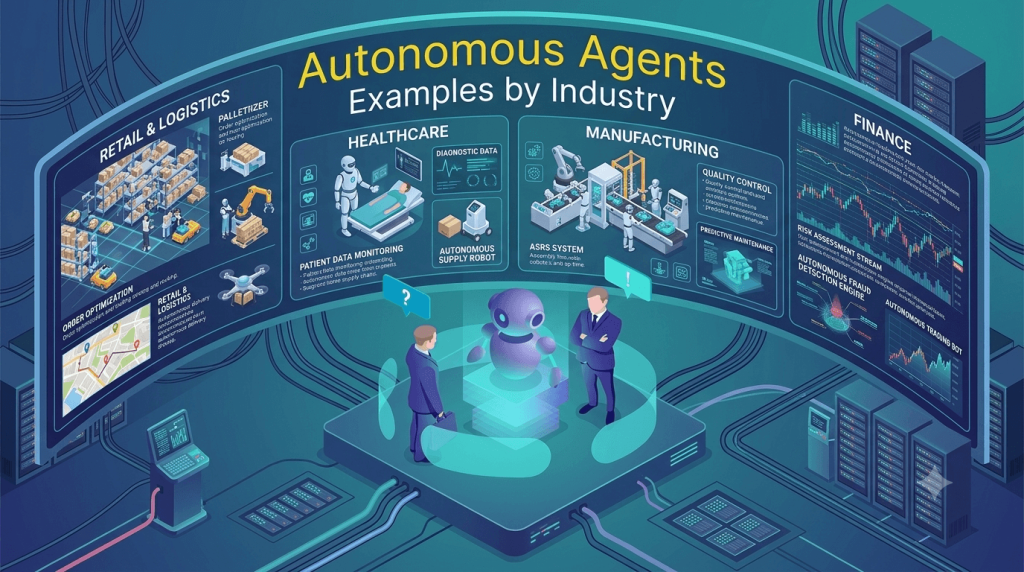
The landscape: banking agents handle underwriting and reconciliation, healthcare agents manage intake and coding, retail agents optimize pricing and merchandising, insurance agents triage claims, manufacturing agents schedule maintenance, logistics agents re-plan routes, and support agents resolve tickets autonomously.
| Industry | Example autonomous agent task | Business outcome measured |
| Banking and finance | Loan origination agent that collects documents, runs KYC/AML checks, scores the application, and drafts a decision recommendation | Time to decision, straight-through processing rate |
| Healthcare | Intake and coding agent that reads a visit note, proposes ICD-10 and CPT codes, and files a prior authorisation request | Days to authorisation, denial rate |
| Insurance | First notice of loss agent that reads photos and forms, checks coverage, and routes or auto-settles low-risk claims | Cycle time, touchless claim rate |
| Retail and ecommerce | Pricing agent that monitors competitor prices and stock levels, then adjusts prices within defined margin rules | Gross margin, sell-through rate |
| Manufacturing | Maintenance agent that reads sensor data, predicts failures, and opens work orders with parts pre-ordered | Unplanned downtime, mean time to repair |
| Logistics | Dispatch agent that re-plans routes when a delay occurs and notifies customers automatically | On-time delivery, cost per stop |
| Customer support | Resolution agent that reads the ticket, checks the account, issues a refund or reset, and closes the case | Resolution rate without human touch, CSAT |
In every case, the agent’s value derives from the tools it can access, and the outcome metric is a number the business already tracks.
4. Autonomous Agents in Banking and Finance
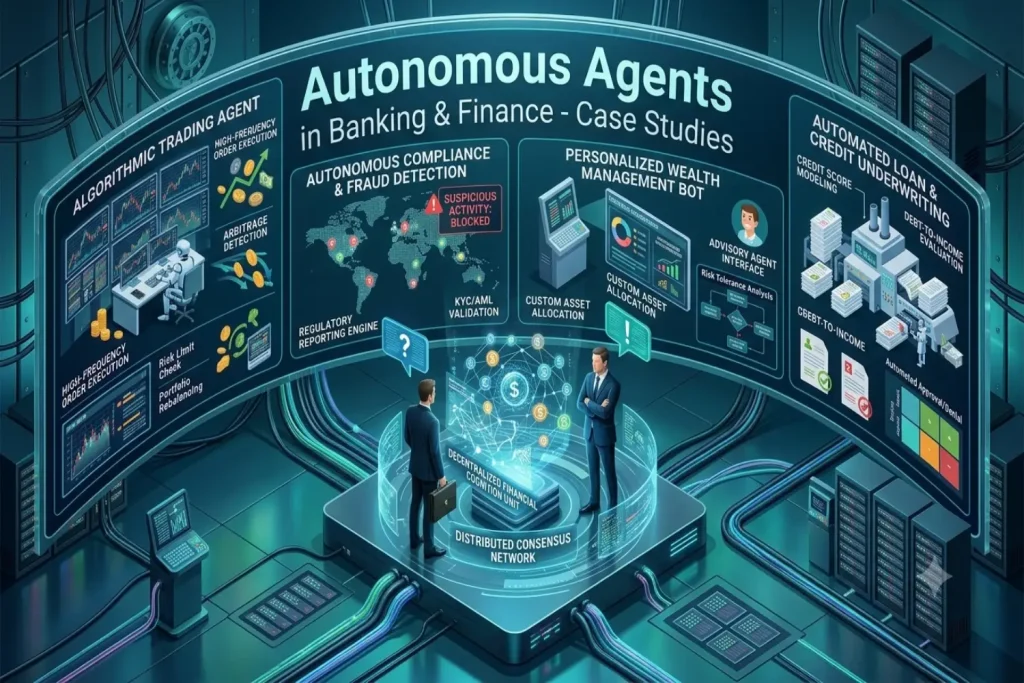
In banking, autonomous agents handle underwriting, fraud review, and reconciliation — the three workflows where decisions depend on multiple systems and every step must leave an audit trail. The agent gathers, checks, and drafts; a human approves anything outside policy.
Underwriting and Origination
A loan origination agent retrieves the applicant’s documents, extracts income and liabilities, queries the credit bureau, runs sanctions and PEP screening, and produces a scored recommendation with supporting evidence attached. KYC and AML checks follow the customer due diligence rules in the FATF Recommendations, so the agent executes those checks consistently and logs each one rather than inventing its own criteria.
Fraud and Transaction Monitoring
A monitoring agent watches transaction streams, clusters anomalies, pulls the customer’s history, and drafts a suspicious activity report for an analyst. The agent does the gathering; the analyst does the judgment.
Reconciliation and Close
A finance operations agent matches ledger entries against bank statements, flags breaks, chases the owning team, and books the correcting entry once approved.
Regulatory note: The EU AI Act lists AI used to evaluate the creditworthiness of natural persons as high risk in Annex III, point 5(b), which brings documentation, human oversight, and logging obligations. Design the audit trail for that from day one.
5. Autonomous Agents in Healthcare
In healthcare, autonomous agents run patient intake, medical coding, and prior authorisation — high-volume administrative work where delay costs the patient care and the provider money. Clinical decisions stay with clinicians. The agents clear the paperwork.
Intake
An intake agent messages the patient before the visit, collects history and insurance details, verifies eligibility with the payer, and writes structured data into the EHR.
Coding
A coding agent reads the encounter note, proposes ICD-10 and CPT codes with the supporting text highlighted, and queues the chart for a coder’s review.
Prior Authorisation
A prior-auth agent assembles the clinical evidence a payer requires, submits the request, tracks the status, and prompts the care team if the payer asks for more.
Interoperability is the gating factor. HL7 FHIR is the standard the agent uses to query patient, encounter, and coverage resources from the EHR, and the ONC lists it as the interoperability standard it invests in for US health data exchange. Older interfaces still speak HL7 v2, so a production healthcare agent usually needs both.
From an agent architect: In regulated healthcare deployments, scope the agent to read and draft, never to submit clinical orders. Every FHIR write passes a validation layer, every tool call is logged with the patient identifier, and PHI never leaves the customer’s cloud boundary. That removes most compliance objections before they are raised.
6. Autonomous Agents in Retail and eCommerce
In retail, autonomous agents set prices, manage merchandising, and resolve customer issues within rules the merchant defines. The value shows up as margin and conversion, so retail is one of the fastest industries to measure agent ROI.
Dynamic Pricing
A pricing agent watches competitor prices, inventory, and demand signals, then adjusts prices within floor and ceiling rules. It needs a clear margin policy and a rollback path, not permission for each change.
Merchandising and Catalog
A catalog agent enriches product data, drafts and tests listing copy, flags attribute gaps, and reorders category pages based on what is selling.
Shopping Assistance and Support
A shopping agent finds products against a customer’s constraints, compares options, and completes checkout. A resolution agent handles returns, delivery questions, and order changes by calling the order management system directly.
| Retail agent | Trigger | Action | Guardrail |
| Pricing | Competitor price change or stock threshold | Reprice within band | Margin floor, max daily changes, brand price rules |
| Catalog | New SKU or low-quality listing score | Enrich attributes, draft copy | Human review for regulated categories |
| Support resolution | Ticket opened | Refund, reship, or update order | Refund cap per case, escalation on sentiment |
7. Autonomous Agents in Insurance, Manufacturing, and Logistics
Across these three industries the pattern is the same: the agent reads a stream of events, decides within policy, and either acts or escalates.
Insurance: Claims Triage
A first notice of loss agent reads the claim photos and forms, checks coverage, scores fraud risk, and routes the claim. Low-value, low-risk claims settle without an adjuster touching them; the rest reach the adjuster with the file already assembled.
Manufacturing: Predictive Maintenance
A maintenance agent reads sensor data from the plant’s IoT platform, predicts which asset is trending toward failure, opens a CMMS work order, and checks parts in the ERP. Unplanned downtime becomes scheduled downtime.
Logistics: Dynamic Dispatch
A dispatch agent watches telematics, weather, and traffic feeds. When a delay hits, it re-sequences stops, reassigns loads where a rule allows, and sends customers an updated ETA.
A rollout sequence that works for all three:
- Pick one event stream — claims, sensor alerts, or shipment exceptions.
- Write the agent’s policy in plain language, then encode it as rules and prompts.
- Run in shadow mode: the agent recommends, humans act, you compare.
- Switch low-risk cases to autonomous action once agreement matches your risk appetite.
- Keep the escalation path and audit log permanent.
8. Who Builds Autonomous Agents in 2026?
Two categories of companies build autonomous agents: platform vendors that sell the agent runtime, and development firms that design, build, and run agents on those platforms for a specific industry. Most enterprise deployments use one of each.
| Provider | Type | Where it fits |
| OpenAI (Agents SDK, Responses API) | Model + framework | Custom agents built by your own engineers on GPT models |
| Anthropic Claude (Agent SDK, MCP) | Model + open protocol | Tool-heavy agents that need long context and MCP connectors |
| Google Gemini (Vertex AI Agent Builder, A2A) | Model + cloud platform | Agents inside Google Cloud data estates |
| Microsoft Copilot Studio | Low-code agent builder | Agents over Microsoft 365, Dynamics, and Azure data |
| Salesforce Agentforce | CRM-native agents | Service, sales, and marketing agents on Salesforce data |
| ServiceNow AI Agents | Workflow-platform agents | IT, HR, and customer workflow automation inside the Now Platform |
| UiPath | Agentic automation + RPA | Agents that orchestrate existing RPA bots and legacy UIs |
| LangGraph, CrewAI, AutoGen | Open-source frameworks | Multi-agent orchestration for custom builds |
If you already run Salesforce or ServiceNow, start with their native agents for workflows inside those systems. If the workflow crosses systems — as a loan file touching a core banking platform, a bureau, and a document store does — you need a custom build on a model plus a framework.
9. How Much Does It Cost to Build an Autonomous Agent?
Cost depends on scope: how many systems the agent touches, how much autonomy it gets, and how regulated the workflow is. A single-task agent is a small project; a cross-system agent in a regulated industry adds security, compliance, and monitoring work.
In 2026, autonomous agent builds typically range from $8,000 to $500,000 depending on autonomy and integration depth, with single-task support agents at $8,000 to $25,000 and workflow agents with CRM integration above that.
What moves the number, by industry:
- Banking and insurance: compliance logging, model risk documentation, core-system integration.
- Healthcare: FHIR integration, PHI handling, validation layers.
- Retail and logistics: real-time data feeds and the rules engine that bounds the agent.
- All industries: evaluation sets and monitoring, which teams consistently underbudget.
A typical build runs in phases: scoping, a shadow-mode pilot, a bounded production release, and expansion.
10. How to Build Autonomous Agents by Industry
Build autonomous agents as bounded, auditable systems, not open-ended assistants. Start with the workflow and the metric, not the model.
1. Workflow and Metric Mapping
Document the process, the systems it touches, and the number the agent must move.
2. Policy Design
Write the decision policy with your domain experts, then encode it as rules, prompts, and approval gates.
3. Tool and Data Integration
Connect the agent over MCP or direct APIs, with FHIR for healthcare and core banking connectors for finance.
4. Evaluation and Shadow Mode
Build a test set from real cases and run the agent beside your team until agreement is high enough.
5. Production and Monitoring
Ship with logging, dashboards, and escalation paths, then widen autonomy in steps.
What’s an Autonomous AI Agent and How Can It Help Me Find a Job?
An autonomous agent is an intelligent software system that operates independently to achieve complex goals without needing step-by-step human prompts. Unlike standard chatbots that simply answer queries one turn at a time, autonomous agents can independently break down objectives, use digital tools, browse the web, analyze data, and execute multi-step workflows. In a job search, an agent acts as a dedicated 24/7 career strategist: it continuously scans job boards for roles matching your exact skill set, automatically tailors your resume and cover letter for each specific job description, conducts deep background research on hiring companies, and manages your application pipeline. By automating the tedious, repetitive tasks of searching, customizing, and applying, an autonomous AI agent transforms a time-consuming job hunt into a streamlined process, letting you focus your energy entirely on networking and acing your interviews.